Building for the Future: Integrating EV Charging into Existing C-Store Infrastructure reviews audits, grid impact, layout, and tax credits to guide operators.
A clerk is counting down the register while a delivery truck idles out back, and your electrician is in the lot explaining that the EV chargers you want don't fit the service you actually have. That's the moment many owners realize that building for the future—integrating EV charging into existing c-store infrastructure—takes more than ordering hardware.
EV charging stresses old assumptions
Most c-stores were built around predictable loads: lighting, coolers, HVAC, kitchen equipment, and a sign. EV charging breaks that model because it adds large, sustained electrical demand in a spot that often has limited transformer capacity, limited switchgear space, and a utility that wants long lead times for upgrades.
The failure mode I see most often is treating EV charging like "just another piece of equipment." It's not. A pair of DC fast chargers can exceed the demand of the rest of the store, and the site's peak demand starts to look like a step function rather than a curve. That affects:
- Service size: Many sites are still on older services that were fine for a remodel but not for high-power charging.
- Demand charges: You may pay for the highest interval peak, even if the chargers are only slammed during commuter surges.
- Reliability: Nuisance trips, thermal issues, and voltage drop show up quickly when gear is undersized or aging.
There's also a business-operational reality: if a dispenser goes down, you can often keep the site running. If the EV chargers are down, drivers will try once, fail once, and you'll see the complaints and chargebacks stack up while your staff has no tools to fix it. Building for the future—integrating EV charging into existing c-store infrastructure—means planning for uptime the same way you plan for fuel.
Start with a power and site audit
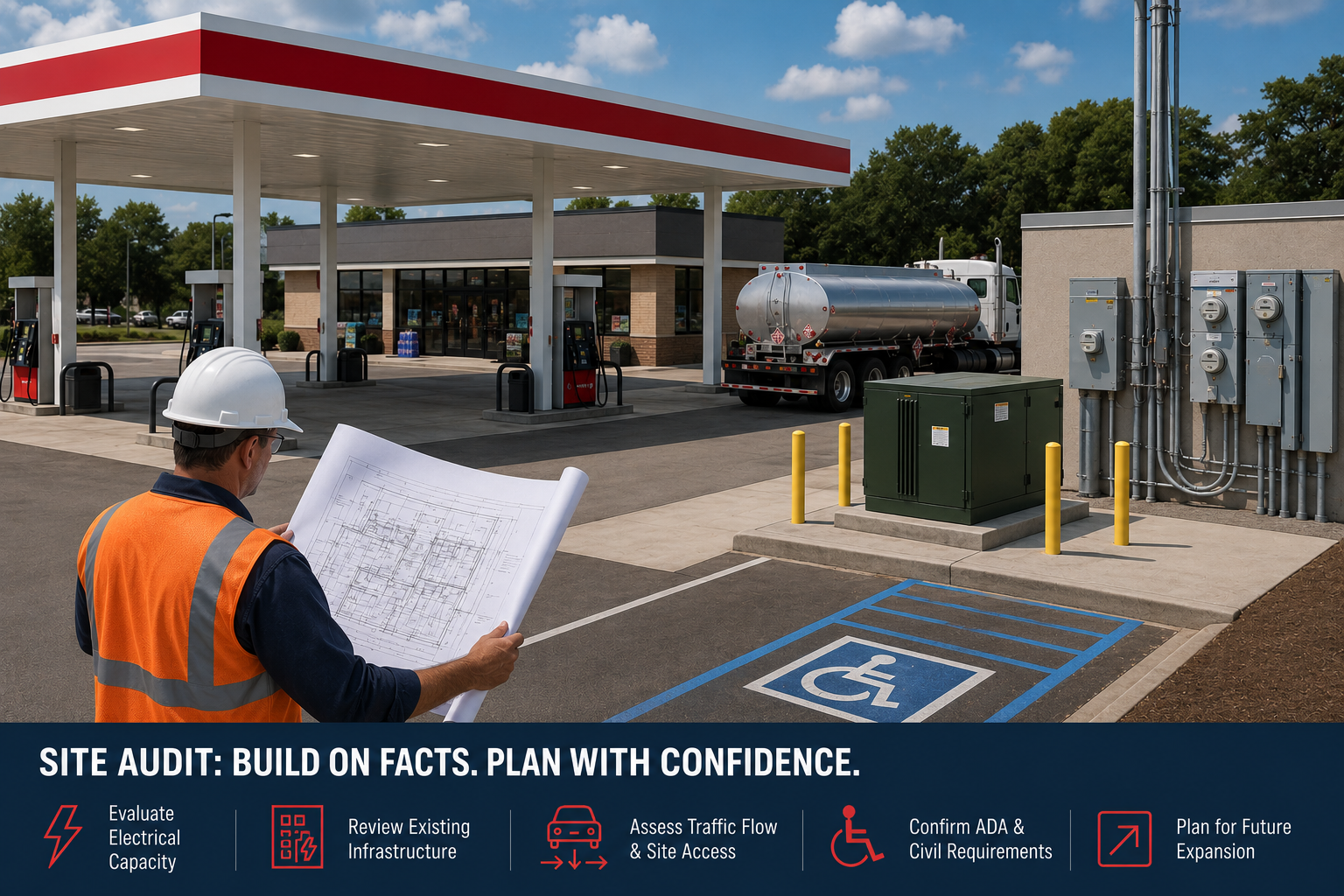
Before anyone talks brands, dispenser counts, or "two ports vs four," you need a hard look at what the site can physically and electrically support. This is where projects stay sane or go sideways.
A practical audit covers:
- Existing electrical service and load Pull utility bills, confirm service voltage, main breaker rating, and actual measured demand. Nameplate sums lie; metering tells the truth. If you're already flirting with the main on hot summer afternoons, EV load will push you into trips or utility penalties.
- Switchgear and panel capacity Check spare breaker spaces, bus ratings, short-circuit ratings, and available physical clearance. Some older panels technically have "space," but no safe way to route new feeders without violating bending radius or crowding gutters.
- Transformer and utility-side constraints The site may need a new pad-mount transformer, new primary, or a secondary upgrade. Utility engineering will care about feeder capacity and neighborhood load, not your schedule.
- Civil and ADA reality Charging stalls aren't "just striping." You need accessible routes, slopes that comply, protective bollards, wheel stops, and curb work that doesn't turn into ponding after the first storm.
- Back-of-house workflow Trash enclosure access, delivery turning radius, and fire-lane clearance all get touched by charger placement. If the new stalls block the ice vendor from swinging the door open, you'll hear about it every week.
A list item that sounds small but becomes a weekly annoyance: plan for where the snow gets pushed. I've watched chargers placed exactly where the plow piles slush and salt—then the pedestals corrode, and the cords freeze into place.
A tight audit is what makes building for the future—integrating EV charging into existing c-store infrastructure—practical instead of painful.
Grid impact and utility coordination
Grid impact is more than "will they give me enough power." It's about how your new load interacts with the utility's equipment and the tariff you'll be billed under.
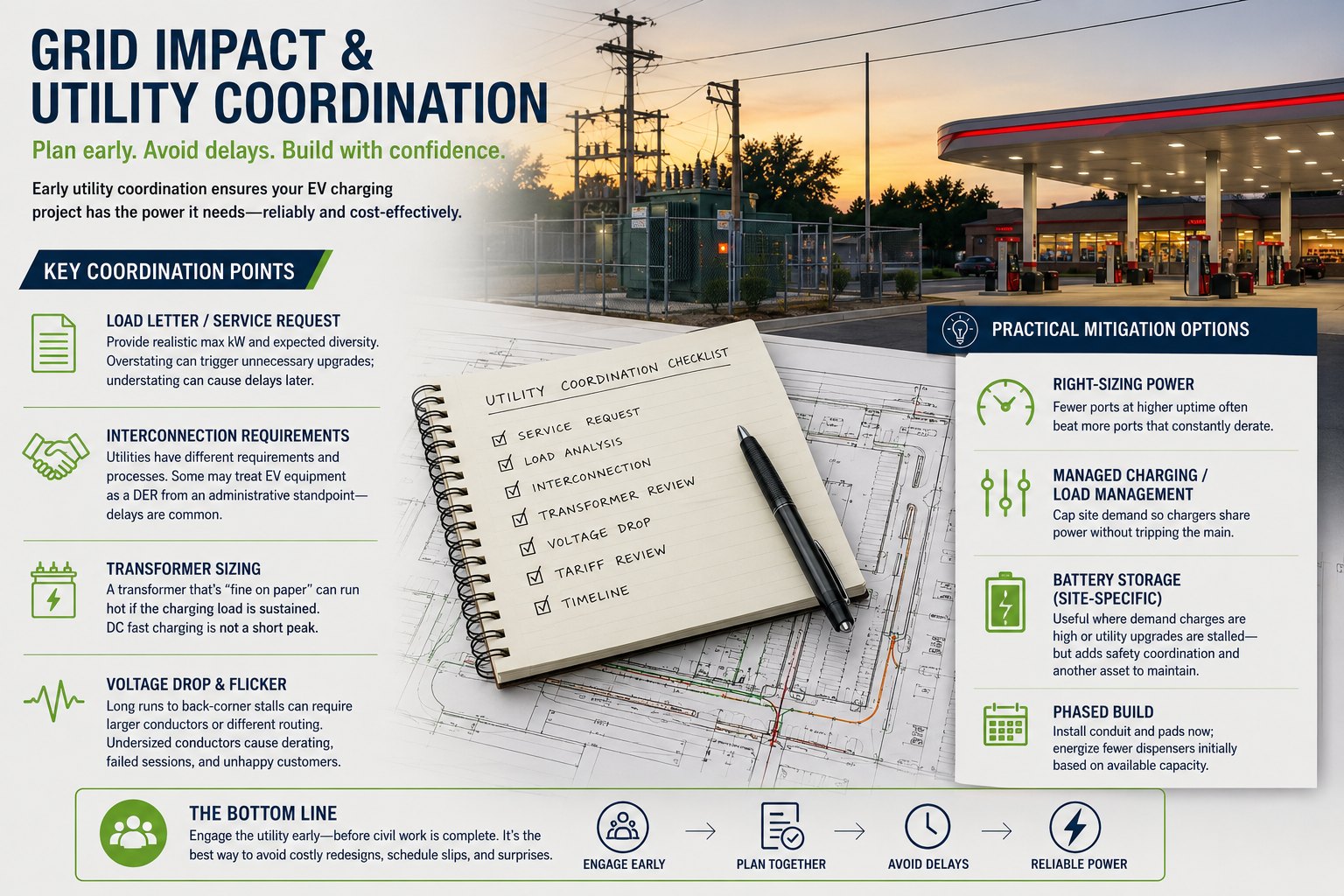
Key coordination points that have to happen early:
- Load letter / service request: Give the utility a realistic maximum kW and expected diversity (how many chargers at once, and at what power). Overstating can trigger unnecessary upgrades; understating can delay interconnection later when they see real usage. - Interconnection requirements: Some utilities treat certain EV equipment like a distributed energy resource from an administrative standpoint, even when it's a pure load. The paperwork varies, but the delays are real.
- Transformer sizing: A transformer that's "fine on paper" can run hot if the charging profile is sustained. DC fast charging is not a short peak like a compressor start. - Voltage drop and flicker: Long runs to a back-corner parking area can require larger conductors or different routing. If you cheap out on conductor size, the chargers derate, sessions fail, and customers blame you—not voltage drop.
Here's the catch: if you wait to engage the utility until after you've poured pads and set equipment locations, you may learn the only acceptable transformer location conflicts with your traffic pattern or underground tanks, and then you're redesigning in the field.
Practical mitigation options depend on the site, but typically include:
- Right-sizing power: Fewer ports at higher uptime often beat more ports that constantly derate.
- Managed charging / load management: Cap site demand so chargers share power without tripping the main.
- Battery storage (site-specific): Useful where demand charges are punishing or utility upgrades are stalled, but it adds fire/life-safety coordination and a new maintenance asset.
- Phased build: Conduit and pads for expansion now, energize fewer dispensers initially based on available capacity.
When you're serious about building for the future—integrating EV charging into existing c-store infrastructure—looping in the utility early is the difference between a clean energization and months of avoidable delay.
Fitting chargers into a working lot
Electrical is only half the fight. You're inserting a new fueling-like activity into a lot that already has fuel islands, traffic flow, and customers who don't read signage.
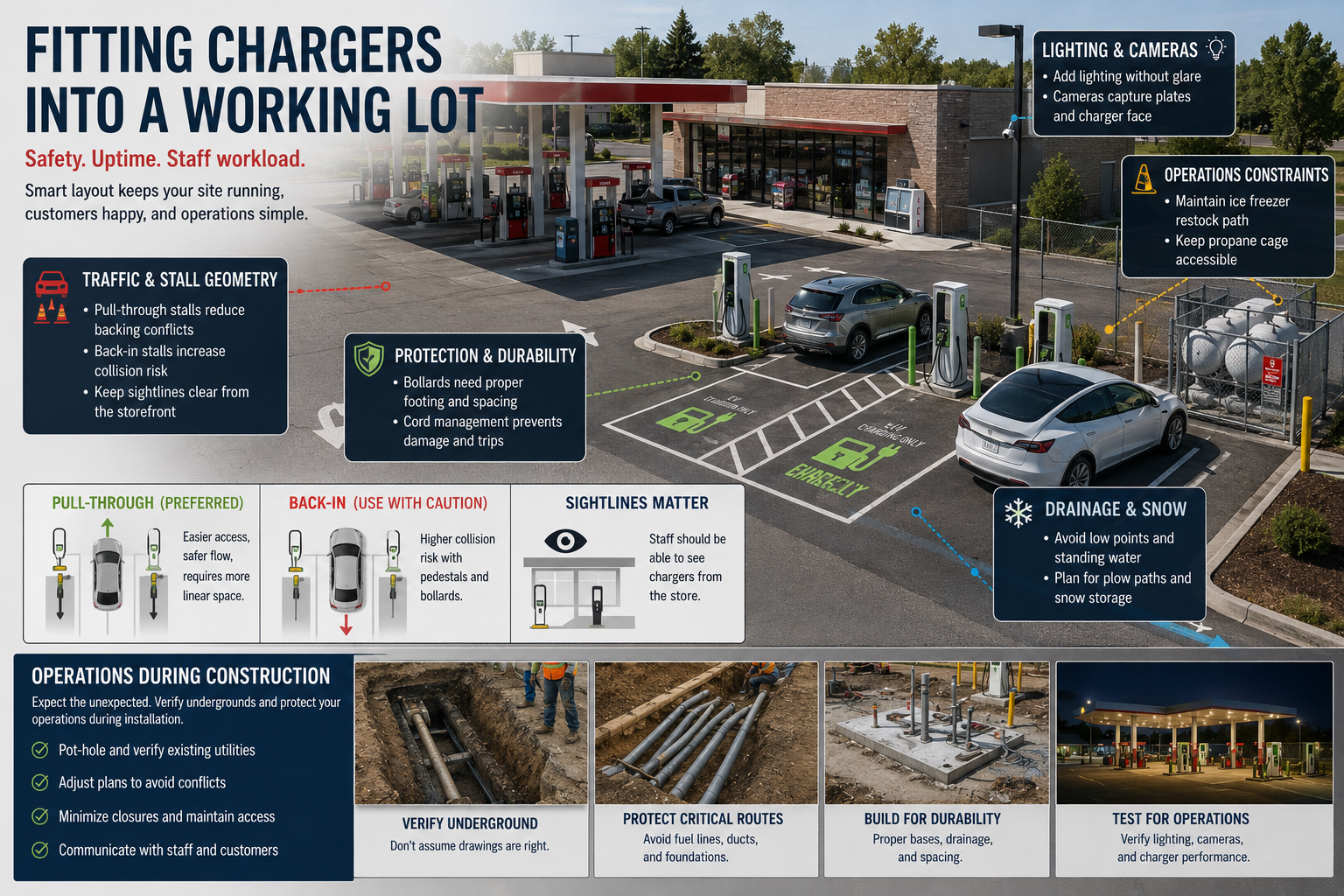
I approach layout with three priorities: safety, uptime, and staff workload.
Traffic and stall geometry
- Pull-through stalls reduce backing conflicts but demand more linear space.
- Back-in stalls can work but raise collision risk with pedestals and bollards, especially with inexperienced EV drivers.
- Keep sightlines clear from the storefront; you want staff to see the chargers without walking outside.
Protection and durability
- Bollards need proper footing and spacing; "just drop a few posts" often ends with a pedestal clipped by a bumper.
- Cord management matters. Cords dragged across asphalt get run over, and then you're replacing handles and dealing with intermittent ground-fault faults.
Drainage and snow
- Don't place chargers at low points where water pools. Standing water plus winter freeze cycles destroy pads and heave conduit.
- Make sure plow paths don't shear off signage or bury cable management.
Lighting and cameras
- Add lighting that doesn't glare into drivers' faces while they're plugging in.
- Camera views should capture license plates and the charger face; you'll need footage for disputes.
Operations during construction This is where plans meet reality. Conduit routes that look clean on drawings run into existing duct banks, abandoned foundations, or unknown patches. If you don't pot-hole and verify, you'll burn money and close parking you didn't plan to lose.
One operational constraint that always shows up: the ice freezer restock path and the propane cage access. If the charger stalls block those routes, staff starts moving cones, customers park where they shouldn't, and the site becomes a daily argument.
Installation: electrical, civil, and networking
EV charger installation is a coordination job disguised as a construction job. The hardware is the easy part; sequencing and verification are what keep the site from reopening with "chargers available" signs and dead screens.
Civil scope that needs real attention
- Sawcut, trench, conduit, backfill compaction, and asphalt patch quality. Poor compaction becomes a trench-shaped pothole in the travel lane.
- Equipment pads need correct anchor templates and clearances for service access.
- Bollards and wheel stops placed to protect equipment without blocking door swing or ADA access.
Electrical scope that drives reliability
- Proper conductor sizing, torque specs, and labeling. Loose lugs cause heat; heat causes failures that look like "random faults."
- Grounding and bonding done to spec, including any separate grounding electrodes required by design.
- Coordination study if required for the new protective devices; selective coordination matters when you don't want a charger fault to knock out the store.
Networking and payments
- Verify cellular signal where the chargers are located; don't assume the store has coverage in the far lot corner.
- If using hardwired internet, plan trenching or aerial routes and protection. One landscaper's shovel can take out your data line.
- Payment acceptance (RFID, app, credit card) is not a checkbox. Each option has different support calls and different failure modes.
Commissioning should include load testing and a documented punch list. "It powers on" is not commissioning. You want to see stable sessions, proper power delivery, clean shutdown behavior, and back-end reporting.
Alternative Fuel Infrastructure Tax Credit basics
This section is deliberately brief because tax treatment depends on facts Noble Fueling Solutions doesn't control in a generic article: your entity type and tax posture, the site address qualifying rules, and the final placed-in-service documentation. Two specific constraints: I can't verify whether a given Melville-area parcel meets eligibility mapping without your address, and I can't determine what costs your CPA will treat as eligible (equipment vs certain electrical work) without your invoices and contract structure. The next step is aligning project documentation to what your tax advisor will actually file.
That said, the Alternative Fuel Infrastructure Tax Credit is commonly used to offset a portion of eligible EV charging and related installation costs, and it tends to reward organized recordkeeping more than clever guesses. Keep clean copies of:
- Contracts and change orders
- Itemized invoices (separate equipment, electrical, civil)
- Proof of payment
- Utility interconnection approvals
- Photos and as-built drawings showing equipment installed and operational
If you build with the credit in mind from the start, you avoid the end-of-project scramble for missing paperwork.
An operational handoff in Melville
Noble Fueling Solutions in Melville, NY can put structure around the messy part: validating power, layout, and documentation before you commit to equipment and concrete. The deliverable that keeps projects from drifting is a site-specific EV charging integration assessment: measured load review, utility coordination checklist, preliminary one-line and conduit approach, stall layout constraints, and a documentation package outline for the Alternative Fuel Infrastructure Tax Credit—delivered as a written assessment plan.
If you're ready to turn concept into a buildable plan, we'll help you build for the future by integrating EV charging into existing c-store infrastructure without blind spots. That means fewer redesigns, fewer surprises from the utility, and chargers that go live and stay live.